On the evening of September 9, 2025, I was sitting in my apartment in the United States, thousands of miles from home, scrolling through my phone with a knot in my stomach. Nepal was on fire. Not figuratively. Literally. The Singha Durbar, the ornate 19th century palace complex that houses my country's government ministries, was engulfed in flames. Armed police had fired live rounds into crowds of students. Dozens were dead. My feed was full of shaky videos, screaming, smoke, chaos.
And then I saw the photograph.
Someone had climbed the golden gates of Singha Durbar and hung a flag. Not the Nepali flag. Not a political party banner. It was a black flag bearing a cartoonish skull and crossbones, the skull grinning wide, wearing a straw hat. The Jolly Roger of the Straw Hat Pirates. Behind it, the seat of the Nepali government burned orange against the night sky.

I felt my breath catch. I knew that flag. I had known it since I was a kid. It was the flag of Monkey D. Luffy, the fictional pirate captain of One Piece, the manga and anime series I had grown up watching, debating, obsessing over with friends. It was the symbol of a ragtag crew of misfits sailing the seas in search of treasure and freedom, battling a corrupt World Government that believed itself untouchable. And now it was hanging on the gates of my country's parliament while the building burned.
That image will stay with me for the rest of my life. It is the moment I understood, in my bones, that a story I had always loved as entertainment had become something else entirely. It had become a weapon. A banner. A declaration of war by an entire generation against the systems that had failed them.
This is the story of how a pirate flag from a Japanese manga became the defining symbol of the largest wave of youth-led protests the world has seen in decades. From Jakarta to Kathmandu, from Antananarivo to Manila, from Dhaka to Rabat, young people have raised the Straw Hat Jolly Roger over burning government buildings, at the gates of presidential palaces, in marches of hundreds of thousands. Two governments have fallen with that flag flying overhead. A third nearly collapsed. Officials have called it treason. Amnesty International has defended it as free speech. And the man who drew it, the reclusive Japanese mangaka Eiichiro Oda, has said nothing at all.
To understand why, you need to understand the story behind the skull in the straw hat.
The Story Behind the Flag
A 28-year political allegory disguised as a children's adventure
One Piece is not just a manga. It is the most successful comic book series ever created by a single author. Since Eiichiro Oda began publishing it in the pages of Weekly Shonen Jump in July 1997, it has sold more than 520 million copies worldwide, earning a Guinness World Record. It has spawned an anime television series with over 1,100 episodes, multiple feature films, video games, and a live action Netflix adaptation that became one of the platform's most streamed franchises, drawing over 174 million views between 2023 and 2025. In much of Asia, Southeast Asia, and increasingly Africa and Latin America, One Piece is not a niche interest. It is a cultural language spoken by hundreds of millions.
The story follows Monkey D. Luffy, a 17 year old boy with a rubber body (the result of eating a supernatural fruit) and an impossibly big dream: to find a legendary treasure called the "One Piece" and become the King of the Pirates. He assembles a crew of outcasts, each with their own broken pasts and fierce loyalties. A swordsman who fights with three blades. A thief who draws maps of the world. A liar who wants to be brave. A chef who feeds the hungry. A doctor who is literally a tiny reindeer. Together, they are the Straw Hat Pirates, named for the battered straw hat Luffy wears, a gift from the man who inspired him to go to sea.
If that sounds lighthearted, even childish, that is by design. Oda wraps one of the most politically sophisticated fictional universes ever constructed inside the bright packaging of a shonen adventure. Beneath the rubber punches and silly character designs lies a 28 year meditation on power, corruption, historical erasure, and the meaning of freedom.
The true antagonist of One Piece is not a single villain. It is the World Government, a monolithic regime that has ruled the world for 800 years. At its apex sit the Celestial Dragons, also called the World Nobles, the direct descendants of the twenty kings who founded the World Government eight centuries ago. The Celestial Dragons live in a holy city above the rest of the world, literally and symbolically. They are above the law. They can enslave, torture, and kill anyone they wish with total impunity. If a commoner so much as raises a hand against a Celestial Dragon, a Marine Admiral, the military's most powerful weapon, can be dispatched to annihilate an entire island in retaliation.
They are, in essence, hereditary oligarchs who treat the rest of humanity as disposable.
Below the Celestial Dragons, the Marines serve as the World Government's military arm. They are not all villains. Many individual Marines are decent, even heroic. But the institution itself is rotten, frequently deployed to enforce unjust laws, protect the privileges of the nobility, and commit atrocities in the name of a "justice" defined by those at the top. One of the series' most memorable speeches comes from the pirate warlord Donquixote Doflamingo, who captures this cynicism perfectly: justice, he declares, belongs to whoever wins. The powerful define what is right. Everyone else endures what they must.
Perhaps the World Government's most chilling tool of control is the Void Century, a hundred year period of history that has been completely erased from all records. Studying the Void Century is the world's greatest taboo. Anyone who attempts to uncover this forbidden knowledge can be targeted for annihilation, not just the individual scholar, but their entire island, their entire civilization, wiped from the map by a military order called a Buster Call. The World Government's legitimacy rests on the suppression of historical truth. In one of the series' most devastating storylines, the scholars of Ohara, an island dedicated to the pursuit of knowledge, are massacred to the last child for the crime of reading ancient stones.
Against this system, the Revolutionary Army operates in the shadows. Led by Monkey D. Dragon, who happens to be Luffy's father, the Revolutionaries do not seek to become rulers themselves. They seek to destroy the Celestial Dragons and dismantle the structures that keep them in power. Dragon's second in command is Sabo, Luffy's adopted brother, who was himself nearly killed by a Celestial Dragon as a child. During the Reverie arc, a summit of the world's kings, Sabo and the Revolutionaries infiltrate the holy city, free enslaved people, destroy the Celestial Dragons' food supply, and declare open war.
And then there is Luffy himself. He does not call himself a revolutionary. He has no ideology, no manifesto, no political program. He simply refuses to tolerate injustice when he sees it. When a tyrant enslaves a village, Luffy fights. When a government erases history, Luffy asks why. When the Celestial Dragons claim to be untouchable, Luffy punches one in the face.
This is why One Piece resonates at protests, and why it resonates more deeply than any other fictional property. The story does not offer a simple tale of good versus evil. It offers a complete political vocabulary: hereditary elites who live above the law, a military that serves the powerful rather than the people, a history rewritten to protect the ruling class, a system that co-opts potential threats rather than confronting them, and ordinary people who are told to be grateful for the scraps. For a generation watching their governments fail them in precisely these ways, the parallels are not subtle. They are structural.
The Straw Hat Jolly Roger, then, is not just a fan symbol. In the world of One Piece, when a pirate crew raises its flag, it is a declaration: we exist, we are free, and we will not submit. When young people around the world began raising that same flag in 2025, they were speaking the same language.
Where the Flag First Flew
July — August 2025
The story begins in Indonesia, the world's fourth most populous nation and third largest democracy, in the sweltering weeks of July 2025.
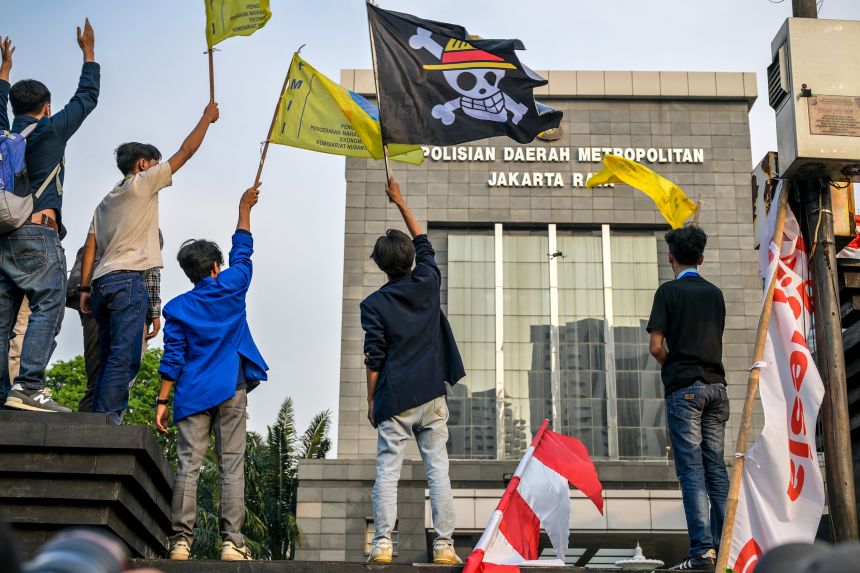
President Prabowo Subianto, still in his first year in office, issued a directive urging all citizens to fly the national red and white flag throughout August to celebrate the 80th anniversary of Indonesian independence. It was meant to be a patriotic moment. What he got instead was a rebellion wrapped in a cartoon.

It started with truckers. Drivers across Java had been protesting a government crackdown on overloaded cargo vehicles, known as ODOL trucks, which the state said were destroying roads. The truckers countered that overloading was the only way to survive in an economy where clients demanded 25 tons of cargo for the price of 10. In late July, some began replacing the national flag on their trucks with the Straw Hat Jolly Roger. It was defiant, funny, and instantly recognizable to anyone under 35.
The trend spread with extraordinary speed. Within days, the Jolly Roger was appearing on homes, motorbikes, fishing boats, and public flagpoles across the archipelago, often hanging right next to the national flag. One apparel shop reported receiving thousands of orders for the pirate flag after Prabowo's speech. The owner told reporters that the anime "reflects the injustice and inequality that Indonesians experience." The timing was devastating for the government. In a country where corruption is endemic, where the Corruption Eradication Commission had been systematically weakened through legislative changes, where six ministers from the previous administration had been implicated in graft, the call for patriotic unity felt hollow. Indonesians were being asked to celebrate the nation while the nation's leaders enriched themselves.
The government's response was a masterclass in overreaction. Coordinating Minister for Political, Legal, and Security Affairs Budi Gunawan warned that the flags were a "potential threat" that could "compromise the dignity of the nation." Deputy House Speaker Sufmi Dasco Ahmad, citing intelligence reports, declared the trend a "systematic movement" and a "coordinated attempt to divide the nation." Representative Firman Soebagyo went furthest, calling it "treason" and demanding police interrogate anyone flying the flag.
The authorities had walked into a trap. By treating a cartoon flag as a national security crisis, they validated exactly what the protesters were saying: that the government was out of touch, authoritarian, and more concerned with symbols of obedience than with the substance of governance. Amnesty International issued a statement calling on the Indonesian government to "stop repressing freedom of expression." On social media, the response was gleeful. Every seized flag, every erased mural, every overwrought official statement only amplified the symbol's power. The flag offered what scholars of protest call "plausible deniability." When confronted, any Indonesian could simply shrug and say: "It is just a cartoon." And the government would have to choose between looking paranoid and looking weak.
On August 25, the protests escalated dramatically. Following reports that members of parliament were receiving lavish housing allowances while inflation crushed ordinary families, mass demonstrations erupted across Jakarta, Surabaya, and other major cities. A 21 year old motorcycle courier named Affan Kurniawan was killed by a police tactical vehicle during the protests, galvanizing further outrage. Indonesian muralist Kemas Muhammad Firdaus, finishing a spraypainted mural of the Jolly Roger, told Reuters that the image was "a symbol of warning for the government, so they have to look at their people."
Indonesia was the spark. But the fire was about to cross borders.
The Precursor That Proved It Could Be Done
July — August 2024
Before the Straw Hat flag became a global phenomenon, another youth revolution had already demonstrated that Generation Z could bring down a government. The July Revolution in Bangladesh in 2024, while not defined by the One Piece symbol, is the essential precursor to everything that followed. It proved the template. It showed the world that students in school uniforms, organized through social media, could topple a regime that had held power for 15 years.

The trigger was deceptively specific: a court ruling in June 2024 that reinstated a 30 percent quota in civil service jobs for the descendants of freedom fighters from Bangladesh's 1971 liberation war. To young Bangladeshis facing a brutal job market, the quota system was not just unfair. It was a mechanism for the ruling Awami League to reward its loyalists and their families while shutting out an entire generation of qualified graduates on the basis of bloodline rather than merit. The parallels to the Celestial Dragons of One Piece, a hereditary class maintaining its grip on resources through inherited privilege, would not have been lost on the anime fans among them.
What began as campus demonstrations at Dhaka University in early July escalated with terrifying speed after the government of Prime Minister Sheikh Hasina responded with overwhelming force. Security forces, joined by the youth wing of Hasina's party, launched what human rights organizations would later call the July Massacre. Between July 16 and August 5, 2024, over 1,500 people were killed. Students were shot with live ammunition. Helicopters fired into crowds. The internet was shut down. A nationwide curfew was imposed.
But the crackdown only strengthened the movement's resolve. The walls of Dhaka became the movement's canvas. Graffiti appeared everywhere: "Killer Hasina," "Stop Genocide," "If you are scared, you are finished; but if you resist, you are Bangladesh." Anime style characters defending democracy were painted on walls opposite the national parliament building. Rap songs became anthems.
On August 5, 2024, Sheikh Hasina resigned and fled to India. She had been in power for over a decade. Nobel laureate Muhammad Yunus was appointed to head an interim government. Bangladesh's new banknote designs would later be inspired by the protest graffiti.
The Bangladesh revolution did not prominently feature the One Piece flag, though anime style art and One Piece graffiti appeared on the streets of Dhaka. But its significance for the global movement cannot be overstated. It proved three things that every subsequent protest would build upon: that a leaderless, digitally organized, youth driven movement could achieve regime change; that the same tools of organizing, primarily social media and encrypted messaging, could outmaneuver state surveillance; and that Gen Z was not the apathetic, screen addicted generation its critics claimed. When Indonesian, Nepali, and Malagasy youth took to the streets months later, they did so knowing that their peers in Bangladesh had already walked the path. The trail had been blazed.
The Flag That Helped Topple a Government
September 2025
If Indonesia was where the flag first flew and Bangladesh was the proof of concept, Nepal was where the Straw Hat Jolly Roger became inseparable from revolution. It was in Kathmandu that the flag achieved its most iconic image. And it was in Nepal that a government fell in two days with that flag on the gates of power.
The spark came on September 4, 2025, when the government of Prime Minister K.P. Sharma Oli banned 26 social media platforms, including Facebook, YouTube, WhatsApp, and TikTok, for failing to comply with registration requirements under a 2023 directive. In a country where social media was the primary means of communication, information, and commerce for an entire generation, the ban felt like having the oxygen turned off.
But the social media ban was only the match. The fuel had been accumulating for years. Under the hashtag #NepoBaby, a movement had already been building online, driven by outrage at the staggering gap between the lives of ordinary Nepalis and the children of the political class. Politicians' sons and daughters posted Instagram stories from luxury resorts, designer shopping trips, and sports cars, while youth unemployment soared and qualified graduates fled the country in record numbers to find work abroad. The slogans that would soon fill the streets of Kathmandu captured this rage with precision: "Gen Z won't be silent." "Your luxury, our misery." "Nepo Babies."

On the morning of September 8, thousands of young people gathered at Maitighar Mandala, a roundabout in central Kathmandu that has long served as a staging ground for public demonstrations. Many were students, some still in their school uniforms. They carried banners reading "Youth Against Corruption." And among the national flags and handwritten placards, the Straw Hat Jolly Roger appeared.
What happened next was among the deadliest episodes of state violence against civilians in Nepal's modern democratic history. As protesters moved toward the Federal Parliament building and the Singha Durbar complex, armed police responded with tear gas, rubber bullets, and then live ammunition. The protests, initially peaceful, exploded. Government buildings were set on fire. Politicians' homes were torched. In the chaos, at least 72 people were killed, including 22 protesters, 3 police officers, and 10 prisoners shot while attempting to escape. More than 2,100 were injured.
And on the gates of the burning Singha Durbar, someone hung the Jolly Roger.
The image went viral instantly. It was shared millions of times across the platforms that the government had tried to ban. It appeared on news broadcasts around the world. It became, in a single frame, the defining image of the 2025 protest wave: a cartoon pirate flag against the backdrop of a collapsing government.
On September 9, Prime Minister Oli resigned. In a development that could only belong to this generation, protesters organized a vote on the messaging platform Discord to support Supreme Court Justice Sushila Karki, known for her anti-corruption stance, as interim prime minister. She was sworn in, becoming Nepal's first female head of government. Elections were scheduled for March 2026.
A 23 year old Nepali protester, speaking to NPR on condition of anonymity for fear of retribution, explained why the flag mattered. "In addition to entertainment, the Straw Hat pirates symbolize freedom, liberty, the spirit that you have to oppose unjust authority," he said. "That really inspired me."
The Straw Hat Jolly Roger had not just been present at a revolution. It had become the revolution's face.
Ghost Projects and Stolen Futures
September 2025
The Philippines was next. And the grievance that drove young Filipinos into the streets was almost too perfectly suited to the One Piece narrative to be real.
During the 2025 monsoon season, severe flooding devastated communities across the island nation. In the aftermath, investigators and journalists uncovered a scandal of staggering proportions. Billions of pesos had been allocated to flood control infrastructure projects that were declared complete by government officials and contractors. But when communities went to check on the levees, drainage systems, and flood barriers that were supposed to protect them, they found nothing. The projects did not exist. They were "ghost projects," entries on a ledger that corresponded to no physical reality. The money had simply vanished.
On September 21, 2025, tens of thousands of Filipinos converged on Luneta Park in Manila for what was called the Trillion Peso March, named for the estimated scale of the stolen funds. The One Piece flag was everywhere. Vendors along the march route sold straw hats, and protesters donned them as they walked. At the University of the Philippines Diliman in Quezon City, an anti-corruption run drew over a thousand participants, many carrying the Jolly Roger.
One young protester, speaking to the Manila Bulletin using only the name Nico (itself an apparent reference to Nico Robin, the One Piece archaeologist who survived the government's massacre of her homeland), explained why the symbol resonated. "We relate to him," the protester said of Luffy, "because he keeps fighting for what is right for the people even when the power is against him."
In One Piece, one of the most emotionally devastating arcs involves Nami's home island of Cocoyama, which is held hostage by the pirate Arlong. Arlong's reign of terror is enabled by a corrupt Marine officer who takes bribes to look the other way while an entire community is exploited. The system does not fail Nami's village by accident. It fails by design. For Filipinos watching their flood control funds disappear into the pockets of politicians and contractors while their neighborhoods drowned, the parallel required no explanation.
From Blackouts to a Coup
September — October 2025
If the One Piece flag's journey through Asia was remarkable, its passage to the island nation of Madagascar was extraordinary. Here, on one of the poorest countries on Earth, the flag did not merely accompany a protest. It accompanied the overthrow of a president and the collapse of a government in under three weeks.
Madagascar, a former French colony of 30 million people off the southeastern coast of Africa, is a nation where 75 percent of the population lives below the poverty line, according to the World Bank. Only 36 percent of the population has access to electricity, and even in the capital, Antananarivo, power cuts of 12 hours or more per day had become routine. Water shortages were equally severe. Residents would queue before sunrise at communal water points, carrying jerrycans, hoping to fill them before the taps ran dry.
On September 25, 2025, after weeks of crippling blackouts and dry taps, young Malagasy took to the streets. The movement called itself "leo délestage," a Malagasy and French phrase meaning "fed up with power cuts." The organizing hub was a Facebook page called Gen Z Madagascar, which gained over 100,000 followers in five days. Its logo was the Straw Hat Jolly Roger, customized for Madagascar: the straw hat had been replaced with a pink and green satroka, the bucket hat traditionally worn by the Betsileo ethnic group. It was a small but powerful act of localization, claiming the global symbol as their own while honoring their heritage.
The Malagasy movement's rallying cry was both literal and poetic: "We do not want power. We want light." They demanded functioning electricity, clean water, and an end to the corruption they believed was responsible for the state's failure to provide basic services.
President Andry Rajoelina, a businessman and media magnate who had first come to power through a military backed coup in 2009, initially tried to contain the situation through a mix of repression and concession. He dismissed his energy minister from New York, where he was attending the United Nations General Assembly. When that failed to calm the streets, he dissolved the entire government. But the protesters wanted more. They wanted Rajoelina himself gone.
The crackdown was severe. Police used tear gas, rubber bullets, and live ammunition. At least 22 people were killed in the first weeks, according to the United Nations. Then, on October 11, something shifted. The CAPSAT, an elite military unit that had historically played a kingmaker role in Malagasy politics, refused to fire on the protesters. The following day, CAPSAT soldiers marched out of their barracks and joined the demonstrators.
On October 13, President Rajoelina fled the country, reportedly boarding a French military aircraft. Parliament voted to impeach him the same day. Colonel Michael Randrianirina of CAPSAT was inaugurated as interim president on October 17. Protesters hung the Straw Hat Jolly Roger, the Malagasy version with its satroka hat, at the Place du 13 Mai in the heart of the capital.
It was the second government toppled with the flag flying. The entire sequence, from the first street protest to the president's flight, had taken less than three weeks.
Stadiums Over Hospitals
September — October 2025
The wave crossed the Mediterranean next. In Morocco, the trigger was not a social media ban or ghost projects. It was something more visceral: eight women dying during childbirth at a public hospital in Agadir in September 2025.
The deaths exposed what many Moroccans already knew but could now no longer ignore. The country's public healthcare system was in crisis. Morocco has only 7.7 doctors per 10,000 people, according to the World Health Organization, far below the recommended minimum of 25. In some regions, the ratio drops to 4.4.
What transformed grief into rage was context. Even as hospitals crumbled, the Moroccan government was spending billions on infrastructure for the 2025 Africa Cup of Nations and the 2030 FIFA World Cup, which Morocco will co-host with Spain and Portugal. Approximately 890 million euros had been allocated to renovate six stadiums. An additional 469 million euros was earmarked for a new stadium in Casablanca. The country was building what would become the largest football stadium in the world. The protest slogan wrote itself: "The stadiums are ready. But where are the hospitals?"
Within days, a leaderless collective called Gen Z 212, named after Morocco's international dialing code, emerged on Discord. The server grew to over 200,000 members. Their demands were sweeping: accessible public healthcare, free quality education, affordable housing, better public transit, subsidies for basic goods, wage increases, job creation, and, notably, the adoption of English as Morocco's second national language after Arabic, replacing French.
Protests erupted across more than a dozen cities. The police response was heavy: over 500 arrests in the first six days, and several deaths reported in clashes. Moroccan celebrities rallied to the cause. Football stars Yassine Bounou and Azzedine Ounahi publicly endorsed the movement. The One Piece flag appeared alongside Moroccan flags in marches, connecting the local struggle to the global wave. The Carnegie Endowment for International Peace called the movement the largest mass protest Morocco had seen since the Arab Spring uprisings of 2011.
The Wider Wave
A pirate flag on every continent
By late 2025, the Straw Hat Jolly Roger had become the most recognizable protest symbol on Earth since the Guy Fawkes mask. Its spread was breathtaking in both speed and geographic range.
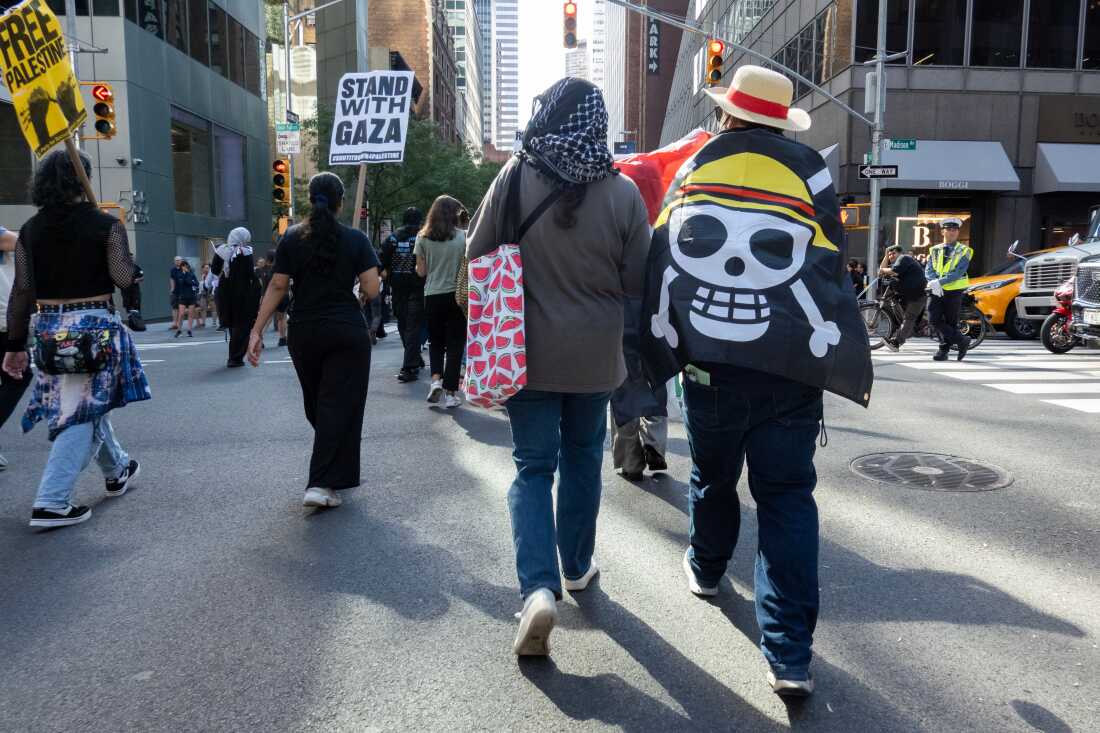
In France, the flag appeared during the Bloquons tout (Block Everything) protests in September 2025. In Peru, it was present at protests against pension reforms in Plaza San Martín in Lima. In Paraguay, anti-government demonstrators in Asunción raised it. In Bolivia, protesters demanding an audit of the 2025 general election waved it in La Paz. In East Timor, university students flew it while protesting lifetime pensions for parliament members.
In Mexico, a group identifying as "Generation Z Mexico" carried it during protests against drug violence. Former Mexican president Vicente Fox was photographed wearing a T-shirt emblazoned with the Straw Hat skull. In the United States, the flag appeared at the No Kings 2.0 protests against President Trump in October 2025, spotted in Los Angeles, Miami, and Spokane. It was also seen at protests against ICE operations in Portland, Oregon. In Italy and Bulgaria, it appeared at demonstrations. The British magazine The Week catalogued its presence in New York, Rome, and Slovakia.
The flag had even been seen at earlier protests, before the 2025 explosion. Turkish protesters used One Piece imagery during demonstrations in March 2025. Bangladeshi activists tagged Dhaka with One Piece graffiti during the 2024 July Revolution. In London, the flag had been waved at a pro-Palestine march as early as November 2023. The seed had been scattered for years. Indonesia was simply the moment it bloomed.
Each country adapted the symbol to its own context. Madagascar replaced the straw hat with a traditional Betsileo hat. Moroccan organizers incorporated the 212 dialing code into their Gen Z branding. Filipino vendors sold physical straw hats at the Trillion Peso March. The flag operated, as scholars of media noted, like open source code: freely adaptable, infinitely remixable, but carrying its core meaning intact wherever it appeared.
Why This Flag? Why This Story?
The anatomy of a perfect protest symbol
The question demands an answer. Pop culture symbols appear at protests all the time. Pro-democracy demonstrators in Hong Kong reclaimed Pepe the Frog in 2019. Protesters in Thailand and Myanmar adopted the three finger salute from The Hunger Games. The Guy Fawkes mask from V for Vendetta has been a fixture since Anonymous adopted it in the late 2000s. So why did the One Piece flag, above all others, become the defining symbol of this particular global moment?
First, there is the depth of the political allegory. Other franchises offer simple narratives of rebellion. The Hunger Games gives us plucky teenagers against a dystopian regime. V for Vendetta gives us an anarchist in a mask against a fascist state. One Piece gives us an entire political system. It gives us hereditary elites, a corrupted military, state censorship, historical revisionism, the co-option of would be reformers, the exploitation of the weak by those who claim to protect them, and ordinary people who are told that the system works for everyone when it visibly works only for those at the top. When a young Indonesian flies the flag, they are not simply saying "I am a rebel." They are referencing a specific, shared understanding of how systemic oppression functions. They are saying: "I see the Celestial Dragons in my own leaders. I see the Void Century in my censored media. I see the World Government in my own state." No other pop culture symbol carries that kind of analytical weight.
Second, there is the shield of ambiguity. A protest banner that says "Down with the Government" can be confiscated and its bearer arrested on clear grounds. But a cartoon pirate flag? It is just merchandise. It is just fandom. When Indonesian officials called it treason, the world laughed. The government was admitting that a fictional story about pirates was a threat to its authority, which was, of course, precisely the point.
Third, there is the emotional resonance of the character at the flag's center. Luffy is not a grim revolutionary. He is not an ideologue. He is optimistic, reckless, fiercely loyal, and fundamentally joyful. He smiles through adversity. He fights not because he hates the system but because he loves his friends and cannot stand to see them suffer. For a generation that has been called apathetic, that has been told it cares about nothing but screens and memes, Luffy is the perfect avatar.
Fourth, and perhaps most importantly, there is the flag's universality. One Piece is available in dozens of languages. Its manga has sold over half a billion copies. Unlike symbols rooted in specific national or political traditions, the Jolly Roger requires no translation. A protester in Antananarivo recognizes it as instantly as a protester in Jakarta. It creates, across borders and languages and cultures, an instant sense of shared identity. When a young Malagasy person sees the flag being raised in Kathmandu, they do not need a translator. They know exactly what it means. They are, in the language of One Piece fandom, nakama. Crewmates.
The Will of D.
In the lore of One Piece, there is a mystery that has haunted the story for nearly three decades: the Will of D. Scattered throughout the world are individuals who carry the initial "D." in their names. Monkey D. Luffy. Monkey D. Dragon. Portgas D. Ace. Gol D. Roger, the original Pirate King. The World Government fears this initial. The Celestial Dragons call those who bear it "the enemy of the gods." The exact meaning of the D. has never been fully revealed, but its essence is clear: it represents an inherited, unkillable spirit of rebellion. No matter how many carriers of the D. the World Government destroys, another rises. The flame cannot be extinguished.
Sitting in my apartment, watching my country convulse through a phone screen, I thought about the Will of D. I thought about how a story I had grown up loving, a story about pirates and treasure and the open sea, had somehow crossed the border between fiction and reality. I thought about the students in school uniforms at Maitighar Mandala, raising a pirate flag while armed police loaded their weapons. I thought about the truckers in Java, the medical students in Antananarivo who just wanted running water, the mothers in Agadir who died because there were stadiums but no hospitals, the Filipinos marching through Luneta Park in straw hats, the Bangladeshi artists who turned the walls of Dhaka into a canvas of revolution.
They did not all speak the same language. They did not all face the same specific grievance. But they shared something deeper: the conviction that the world as it was, was not the world as it had to be. That the powerful were not untouchable. That a generation dismissed as frivolous and screen addicted could organize on Discord, march in the streets, and bring governments to their knees.
Eiichiro Oda, the man who drew the flag, has said nothing about any of this. He rarely comments on political matters. He stayed silent as his creation became the banner of a global uprising. Perhaps that silence is its own kind of statement. In One Piece, the treasure that the Pirate King left behind at the end of the Grand Line, the treasure that gives the series its name, is heavily implied to be not gold, not jewels, not power. It is the truth. The forbidden history of the world. The knowledge of how the World Government came to power and the injustices upon which it was built. To find the One Piece is to uncover the truth, and in doing so, to gain the power to change the world.
For the young people raising the Straw Hat flag in the streets of a dozen countries, the treasure they seek is the same. It is not wealth. It is not power. It is the right to live with dignity in countries that serve their people rather than their elites. It is accountability. It is justice. It is the simple, radical demand to be heard.
The flag is still flying. The story is not over. And if One Piece has taught this generation anything, it is this: the journey to find the treasure is long, and the sea is full of storms. But the crew sails on.
Raise the Jolly Roger.